I'd say it's devolved aggressively at least on mobile. Between the firehose of modal bullshit I didn't ask for, sub-optimal pathfinding, and annoying prompts from waze legacy features there's a ton of unwanted friction added to the process.
"I struggle to sympathise with the idea that jobs themselves are something sacred we should be fighting for."
I struggle to take what is ultimately an unintentional display of the author's privilege seriously. There is no political will to reverse course on 70-odd years of redbaiting that would be a required first step toward any of the changes to resource distribution that would be required to avoid the economy collapsing when jobs start getting scarce. Shoulda coulda woulda oughta, whatever, Big Money threatens capital flight whenever a modest adjustment to simple taxation is suggested. There is no future in which they willingly submit to the kind of redistribution that would be required to finance a society where work is optional.
> There is no future in which they willingly submit to the kind of redistribution that would be required to finance a society where work is optional.
Do they ever willingly submit to anything that results in less money for them? Too early to know if AI will actually reduce the need for jobs, but if it does, are they going to be forced to create positions for roles they don't need, so that there are no job losses? And what will people do in those roles?
"Regex is hard, regex wizardry is rare, and regex engine implementations are inconsistent. It’s very, very easy to accidentally get it wrong without realizing it."
The what now? I'm struggling to take this seriously because a decade ago regex where common knowledge, like if you don't have a handle on this you should probably go get a job in marketing levels of common knowledge. Has the profession fallen off this far in ten years?
Yes, it has fallen off this far in the last ten years.
If you look a little further back, say to 2006-ish it's far worse than that.
Back then there were 'bright' middle-school ROV team members writing C and Ada+Spark for Arduino-board control-by-wire small craft to perform simulated ocean sample collection and tool manipulation tasks and winning in the unlimited class against university competition at international championships.
Now the "Profession" consists of teams using ChatGPT to cheat on basic coding tasks and "make nudify" of famous people from their work machines.
What the actual fuck. It's not like we're talking about sed/awk fuckery or manual memory management. Regex syntax is a basic programming concept that is natively supported in most languages. Next you'll tell me these incompetents can't normalize database tables...
I'd rather see legislation banning crypto mining and AI data centers from the public grid entirely. No sense in forcing the broader public to subsidize them.
The problem with that is one of the best things we have to control pollution at power plants is the rules that go into place when connecting to the US grid (I know TX is different).
I really don’t want to incentivize private power plants that aren’t on grid. Or just running tons of industrial sized generators instead.
If we’re going to allow enough of this stuff to be built that it can destabilize things why not require they behave and don’t stop off like that? Some sort of organized draw down?
And if they don’t? Mandatory cutoff for X amount of time. Weeks/months.
Right, that’s what I was thinking of when I wrote my comment. Regulate back. If there is no will to do so, well, that’s a choice. Write the law, pass the law, aggressively enforce civil and criminal penalties for violations. They haul gas generators in without a license? Confiscate and tear them down for scrap (which will be painful, as these turbines are in short supply and their manufacturers are backlogged years into the future), in accordance with law you pass. Hold the utility liable if they provide a fossil gas pipeline connection. Humans like Elon may not care, but utilities have something to lose. Find “one throat to choke” as the saying goes.
It is not politically easy, but it is logistically straightforward.
The general problem with this approach is that it's not possible for the legislature to simultaneously be deliberative and fast-acting.
If you pass a nuance-free emphatic rule that says no fossil fuel generators, does that include the backup generators at a hospital? If it does and then the hospital loses power, that's not just a political problem, that's a "people will die" problem. But if it doesn't then you're going to turn around and find that Elon Musk's data center is hosting some hospital's IT system and then running the generators (that happen to also power the rest of the entire facility) to keep it online. Time will pass before this loophole can be detected, more time until new rules can be promulgated, and then they'll find a different loophole and the process begins again.
That process tends to make people frustrated and then they want to abandon the rule of law. Stop having rules that say what you can't do and just have rules that say you can't do anything and then selectively prosecute the people you don't like. The modern system has been evolving to work more like that, but that's how you enable people like Trump. Making the system work like that is a disaster.
What you need to do is find a better way to solve the problem in general, like a carbon tax, rather than trying to play whack a mole with overly-specific rules until there is such a thicket of them that you're really playing "show me the man and I'll show you the crime" -- or setting things up for someone else to.
If they weren't on the public grid, they would just slap in a bunch of gas turbines and run one of the noisier, more polluting sources of electricity. I think it would be better if we required them to replace the power they used, but do so on the grid so that it benefits everyone.
The newest one that I know of will use gas turbines as generators and will connect to the grid. [0] It is sited conveniently to operating natural gas compressor stations out in the Barnett Shale field and near to a local lake for water. That lake is effectively a deep mud-hole that has an agreement with a larger regional lake to pipe water from the larger lake to the local lake to help meet local demand.
If you ever visited the town and hit the restaurants during the summer you get a nice taste of the lake bottom when it flips. Pretty nasty yet few restaurants use water filtration to deliver fresh-tasting tea and water to their customers.
That's OT though.
The county will have a special meeting on data centers this Tuesday, June 9 where they are seeking public input. I expect that there will be plenty of people and hope they have time to give people an opportunity to speak. I visit this county regularly for grocery shopping, fuel, etc and if you go south one county there are already plenty of people who are sick and tired of the bitcoin operations and how they have disrupted life in that county. I hope we have a good turnout for this meeting so that this new operation gets canned before they build anything.
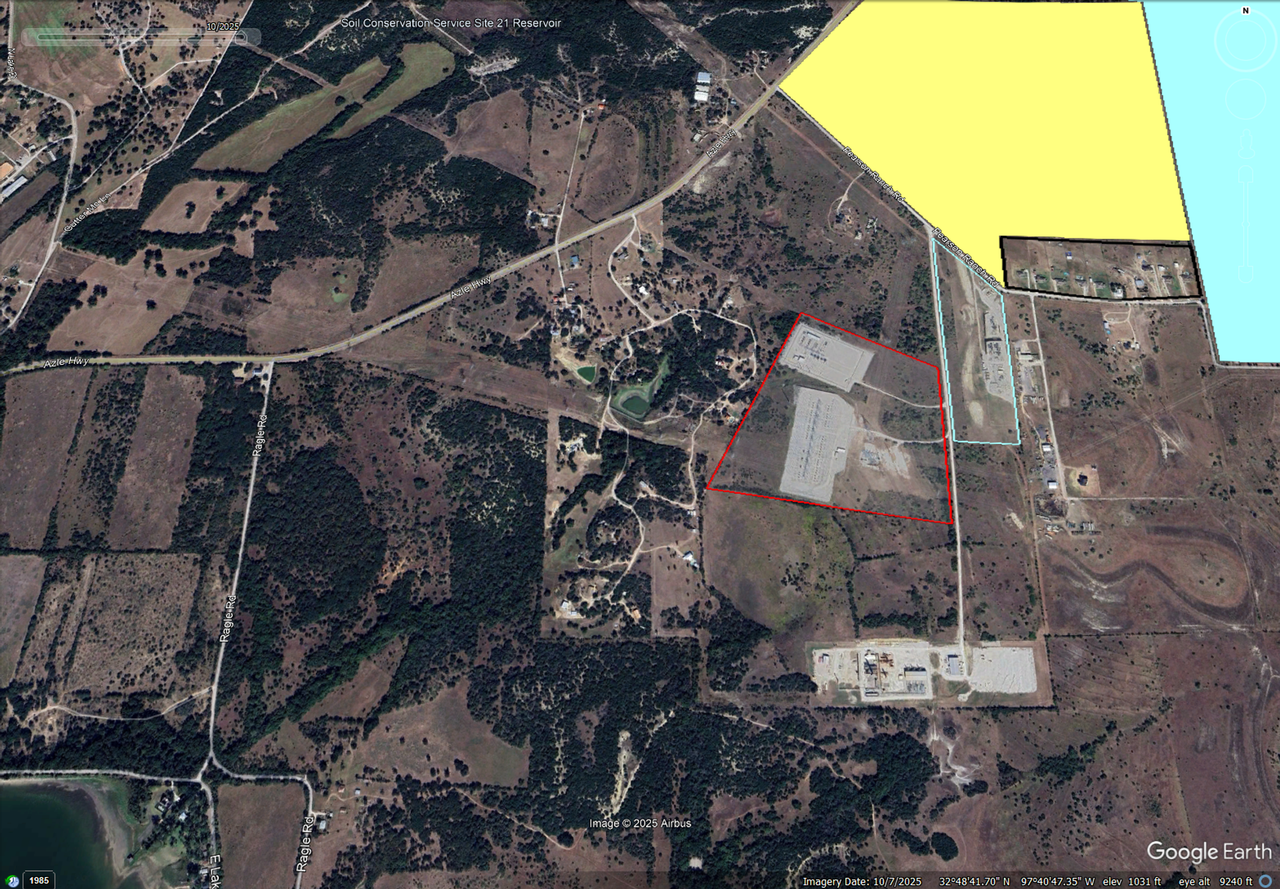
Here is a quick overview of the proposed site. [1] You can see in yellow the 200 acre section where turbine generators will be sited. In the light blue area adjacent you can see a small part of the larger parcel where the data centers will be built. This is part of one of the last large ranches in this part of the county. The others are actively being developed for large (>50000 residents) developments that were supposed to be self-contained communities but which have evolved to be large residential areas that dump traffic onto undersized freeways which are currently under construction to handle the huge volume of new traffic and traffic from all the other losers who will live out there.
The red polygon show existing grid substation intertie where high tension power lines converge or radiate out across the countryside. The light blue polygon is an active natural gas production and compressor station. There is more natural gas infrastructure just below the red polygon too. The lake is obvious in the lower left corner. The natural gas wells and compressor station date to early Barnett Shale production in the county, before 2008. The electrical substation is legacy and has been expanded more than once during the last 15 years.
The black polygon is a small rural subdivision of 8 ~2.2 acre ranchettes around one original ~4.2 acre home site. Those people bought a small plot of ranchland for their own slice of rural Texas. That section was subdivided into lots about 9 years ago so every one of those people bought homes next to an operational gas compressor station. I wonder whether they will be at the meeting.
I'd rather see legislation banning everyone from the grid. Why have a common resource if its no longer common. Just get rid of it. Ban everyone from using the roads, who knows, they might be transporting evil computer hardware to an evil data centre using a road. Farms obviously have to go, they supply food to people who write code that gets run in datacentres. In fact, just ban all trade and commerce to be on the safe side*
*The US should implement this policy for real for my personal amusement.
"Increasing housing supply will absolutely decrease housing prices." True if it's the government building the houses, otherwise you hit a point where construction margins tank well before market saturation is reached. In practice new housing developments have a tendency to drag local real estate prices up (see also: gentrification).
That may be true in a very local area, but if you build something really nice in an area that wasn't very nice, the units that used to be mid are now near the bottom and have to lower their prices.
"the units that used to be mid are now near the bottom and have to lower their prices"
Nah, what actually happens is the lower rung housing is either flipped to capture the increase in area pricing or the lot gets scraped, again to capture the increase in area pricing.
That's not the way it works. The "increase in area pricing" is just the result of adding new units. The older ones don't go up in value, so there's no increase in value to capture.
That's absolutely how it works, I've benefitted from the process several times in some areas and been entirely locked out of the market in others. You might need to closely examine the process (and margins) around house flipping if you're confused on this point.
> In practice new housing developments have a tendency to drag local real estate prices up (see also: gentrification).
This is absolutely false, not true, disproven, and made up.
Social housing builders are good for many reasons, 1) they provide competition to the public market, and when efficient don't need to return profit to shareholders so provide a very good competitor in places like Finland and Singapore, 2) social housing builders smooth out the business cycle, because new housing is needed just as much when at the downturn of the business cycle as at the top, so it greatly helps provide stable employment and a stable workforce for housing construction, greatly improving housing.
But the idea that new idea drives up housing prices in any way is, at best, a fiction. It's mostly a lie from landlords and homeowners to try to justify their continued extraction of profits from their idleness.
"This is absolutely false, not true, disproven, and made up."
Someone should tell the local housing market that then, because this pattern has consistently manifest over the last 20 years here. Without exception everyone I've seen make this claim isn't invested in residential real estate and hasn't closely watched how prices shift in response to new construction. In any event if you're trying to advance the claim that gentrification is a myth you're going to need to bring some serious proof to back that.
It is rather fascinating that you would bring up a "gentrification is a myth claim," why would you try to insert that into my mouth?
Gentrification happens all throughout the US, but in the current era it's from the under discussed type from the original literature in the 1970s: through lack of construction. When there's not enough housing to go around, prices rise, wealthier people are the only ones who win the bidding war, etc etc. See Boyle Heights in LA for a classic example of this. No new buildings, massive gentrification because there's not enough housing to go around.
See also in LA for the neighborhoods where prices are not rising: the only places they are building lots of apartments.
Perhaps there was some era when the "rent gap" style of gentrification was actually prevalent, but it hasn't been that way for decades. It's all just shortage driven gentrification in every example I have been pointed to in recent times.
"It is rather fascinating that you would bring up a "gentrification is a myth claim," why would you try to insert that into my mouth?"
Probably because the sentence you quoted and responded to points explicitly to gentrification as a primary driver of the phenomenon in question. You know, that thing you said was false, untrue, and entirely made up?
"It's all just shortage driven gentrification in every example I have been pointed to in recent times."
Fair enough, allow me to provide a few counter-examples from the regional housing market:
- three massive mixed-use development projects (in different local cities) each added thousands of rental units and mixed walkable retail to what were aging downtown-adjacent neighborhoods. Demand in this quadrant of the city spiked in response. Home prices (regardless of age or condition) in a 10 block radius tripled over the course of 4 years. Surrounding commercial real estate owners where quick to pick up on the increase in traffic and promptly raised commercial rents, driving the majority of pre-existing businesses out. These were (entirely predictably) replaced by national franchises. Area residential landlords, seeing rising commercial rents and real estate prices promptly increased rents.
- There is a phenomenon in local "blue collar" neighborhoods where developers are buying a handful of adjacent lots, scraping the existing structures, subdividing the parcels, and then putting up these utterly vile two and three story skinny block houses that combine all of the worst aspects of private home ownership and apartment living. These new units are generally priced between 175% and 500% of the pre-existing average of similarly sized houses in these neighborhoods. In every neighborhood I've bothered to watch where these things have gone up the sell price of for housing in these neighborhoods has gone up between roughly 75% to 200% over a ~4 year period following. During the same time period cost of similarly sized houses in similar neighborhoods in the area has increased by maybe a 3rd, which suggests that blanket demand for the area isn't the primary driver of the increase.
- Then there's the time two county planning boards colluded with the largest developer in the state to conjure a medium sized bedroom community from thin fucking air (well a swamp actually but you get the idea). ~1k new units added to the market a year for the last decade, targeting the entire spectrum from "affordable" apartments to two golf course communities. The price of housing and lots have skyrocketed in the surrounding area, to the point that section 8 landlords in neighborhoods 10 miles away are backing out of their agreements so they can capitalize on the increase in local rents.
The one thing all of these instances have in common is new capacity was added to an area and local rents and real estate prices increased rapidly.
> But there’s a long way to go between current property prices and raw construction costs.
How much? Searching a bit suggests that net profit margin in housing industry is about 8.7%
Consindering an investor can get ~3.75% in zero risk T-bills without lifting a shovel, that's about an extra 5% net profit to get involved in building housing.
Which isn't nothing, it's a decent profit. But I also wouldn't call extra 5% a huge difference.


You ever try to navigate the highway systems in either DC or Houston with verbal instructions enabled? It sounds like someone is having a stroke.
reply