> Only very rarely I have seen examples with obvious differences between monitors when showing green objects, e.g. some documentaries with certain vividly colored animals, like some insects, birds, frogs or lizards.
According to the article you get purified greens from transmittance through foliage, ie backlight in eg a maple forest. This makes me suspect that it may be more important than just exotic animals, and maybe we are more sensitive to ”greens” than we think? For instance, a lot of my photography of trees/forests tend to feel much more ”green brown mess” and loses structure when going from reality to screen. (Another explanation is that my photos are bad, but I like that one less)
> According to the article you get purified greens from transmittance through foliage, ie backlight in eg a maple forest.
This sounds plausible. I think that in general for content that you record yourself, where you would record whatever is interesting, e.g. the more unusual things, especially outdoors, it is more likely for all the parts of the color space to be important.
My point was that for the content most frequently watched on a monitor, like commercial movies, it is much more likely that the main effect of using the obsolete sRGB color space is to see a lot of objects whose color is in the orange/red/purple area and which appear to have washed-out colors.
In almost any commercial movie, if I switch at almost any point between a Rec. 709 copy on an sRGB monitor and a Rec. 2020 copy on a Display P3 monitor I immediately notice some reddish objects that have become more vivid, looking like in real life, while on sRGB they look abnormally dull.
Until a dozen of years ago, I had used for many years sRGB monitors and I was content with them, but immediately after I used for the first time a Display P3 monitor I could no longer enjoy sRGB photographs or movies, because now their limitations had become obvious.
I think the lack of depth perception in a 2D photo is another big factor in why the magic of a forest can’t be captured. There are so many different layers that all get flattened!
There is so much going on in a modern digital camera between what the sensor captures and what is stored on the flash card that you might be a perfectly fine photographer and it’s the software in the camera that just doesn’t get your style.
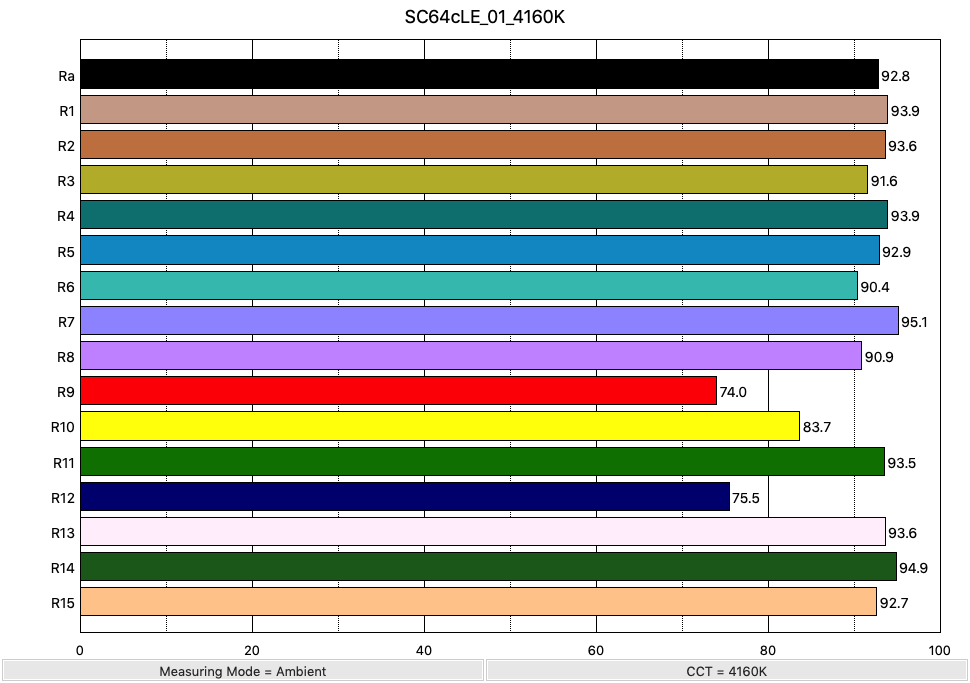
This is truly an (accidental?) setback of color reproduction as it has progressed over time. For LED lights R9 is also crucial for skin tones which makes it so bad to just leave that out. Now, the mass produced LEDs are even optimized for CRI at all are virtually all excluding R9, which may be one of the main quality issues that many people perceive with LEDs vs eg incandescent. There’s of course more to it but R9 probably has a disproportionate effect for being a ”minor detail”.
It is not reported often by the manufacturer, but SSI and TLCI numbers can be a better metric if available. They are used by the Broadcast/Photography community to match the spectrum's similarity to Sunlight.
TM-30 for general illumination, since it's based on human perception, not on what's best for a sensor like TLCI. Particularly the overall Rf and the h1 bin (skin tones) will tell you the most. Also color temperature accuracy if you want to match it with natural lighting and other lights.
> The report made it sound like it is some kind of semi-official EU-endorsed project, but its just... a closed source, for-profit social network?
This is so stupid. It’s really like truth social. Having a private company with closed source pretending to be open and sovereign (whatever that means), adding ID verification by scanning your passport, it’s like.. gasoline for conspiracy theories. They’re so incredibly tone deaf. It’s like being back in the early 2000s when the older generation didn’t understand the internet. But it’s 2026…
Just skip the extra steps of putting social media makeup on a centralized mouthpiece, and make it an official EU site with broadcast only comms. Like public announcements and the like. That would at least serve some value. You can’t have both the social part and the control of the narrative.
What more do you expect from German and EU leadership?
>Just skip the extra steps of putting social media makeup on a centralized mouthpiece, and make it an official EU site with broadcast only comms. Like public announcements and the like.
Yeah but then nobody would ever read it. Which is why EU leaders want to coerce private platforms that are already highly successful with the public be their mouthpieces.
Both ”creative mythical noble artist” and ”creative work is just work” are unhelpful strawman arguments. One is elitist, the other is reductionist.
Creativity is neither a property of who you are or what you do. It’s about how you do it. It’s closer to a mindset of curiosity, wonder and play. For example, many programmers have a need for creativity within coding, but don’t feel they get it at their 9-5 job, and instead work a side project (like FOSS, indie game) because it’s a more creative experience. The point is: same person, same activity yet one is more creative than the other.
The art/artifact itself is not creative. It’s the process that’s creative. Building a car can be creative. Buying a car is not. That’s not romanticizing and gatekeeping people who don’t have time to build a car. It would be genuinely misleading to equate those things.
> Creativity is neither a property of who you are or what you do
Then you say:
> It’s closer to a mindset of curiosity, wonder and play.
Which has to be the property of what you do (the process) or who you are (the personality willing to embed those values), right?
> It’s the process that’s creative. Building a car can be creative. Buying a car is not.
Sure, but the process is "what you do" which directly contradicts what you're saying.
> For example, many programmers have a need for creativity within coding, but don’t feel they get it at their 9-5 job, and instead work a side project (like FOSS, indie game) because it’s a more creative experience.
Sure but most programmers don't do it. Simillarly many artists work on projects for companies and their own projects. My point is that you cannot reduce commercial work as not creative just because it's a 9-to-5.
I really fail to understand your point with this comment since it's not really saying anything coherent.
You also say
> The point is: same person, same activity yet one is more creative than the other.
Again, if that person is doing that activity then it is what they do i.e. you're calling the process creative. And in this case, we'll call that same person to be creative since they have the drive to work on their own project after a full 9-5 job. But if they were not doing it, we'll still consider them creative since it is a basic requirement at their 9-5. That is my point - both of them are creative. Degrees may vary depending on subjective perception but that was not what was being discussed.
> Sure, but the process is "what you do" which directly contradicts what you're saying.
”What you do” was just short for the _activity_ that you’re doing, eg ”I am coding” or ”I am building a car”, which does not determine the extent of how creative it is. Building ikea furniture from instructions would be low on the creative scale, whereas making a chair from woodworking might be higher, for most people.
> Sure but most programmers don't do [side projects]. My point is that you cannot reduce commercial work as not creative just because it's a 9-to-5.
Of course not, some people find that perfect match. That said, employment is not optimized for creativity, so it simply appears unusual that it’s conducive to highly creative work. This is my theory of why many programmers pick up hobbies outside of 9-5 where they have better preconditions, whether it’s side projects (same domain) or woodworking (different domain). Some find it at their 9-5, and some don’t feel much urge.
> we'll still consider them creative since it is a basic requirement at their 9-5. That is my point - both of them are creative. […] Degrees may vary depending on subjective perception but that was not what was being discussed.
I don’t think it’s even meaningful to discuss creativity without acknowledging that it’s both subjective and that degrees may vary. And yes, problem solving is probably always creative to some degree. But the degree is the important part.
So, I wouldn’t call _them_ creative or not, because again I don’t think it’s a personality trait nor binary. Only the person doing it can tell how creative it feels. Personally I felt mostly uncreative when doing corporate work. I would have loved for it to feel creative, but it didn’t.
> What makes this so beautiful IMHO is that it's a trivial jail break, but also a close to unfixable.
It’s almost as if identifying security holes is a prerequisite for both fixing and exploiting them. But without knowing the color theme of the terminal, there is simply no way of knowing who is good and who is evil.
This is such an obvious observation that I’m surprised to find it often missing. 0.1X is nothing compared to the destruction (ie negative X) you can do with the right combination of recklessness and managerial pressure. Definitely happens with engineers. Perhaps even more with PMs.
UB is especially bad but also not as big as all other concerns combined. Two of the most reliable software ever to exist, curl and SQLite, are C/C++. There are also cases in system programming, drivers etc where the unsafe is necessary and then your code is only as good as the boundary, and lots of bugs can seep in. Another issue with Rust is ecosystem - the dependency trees required to do fairly basic things are often deep and vast, meaning other risks.
That said if something like rsync was written today, I still think Rust may be a better choice. Mainly because a 95 percentile skilled Rust programmer is less dangerous than for C. The people that are skilled enough to be trusted with C are few and diminishing every year.
Video production. Gigabit is 125MB/s. If you’re shooting a day in 10bit 4k (pretty standard today) you have like ~1TB of data. If you need to get that footage to an editor or a post house it would take over 2h at max speed. That’s why many still ship hard drives with courier.
I’ve spent way too much time trying to solve the large file transfer problem using hybrid p2p. Check out https://payload.app/. It’s tested in controlled env for 10Gbps+ but have not been able to test that over WAN just yet. I have 10Gbit residential if someone wants to help benchmark.
> None of HDR10, HDR10+, or DolbyVision ever answered the question of how to adapt for varying ambient brightness levels, either, which is again a very important question to answer for portable devices like phones, tablets, and laptops.
Those are extremely niche use cases. Most normal people watch their TikTok and YouTube on a perfectly calibrated wide gamut HDR OLED in their darkened color grading room.


According to the article you get purified greens from transmittance through foliage, ie backlight in eg a maple forest. This makes me suspect that it may be more important than just exotic animals, and maybe we are more sensitive to ”greens” than we think? For instance, a lot of my photography of trees/forests tend to feel much more ”green brown mess” and loses structure when going from reality to screen. (Another explanation is that my photos are bad, but I like that one less)
reply